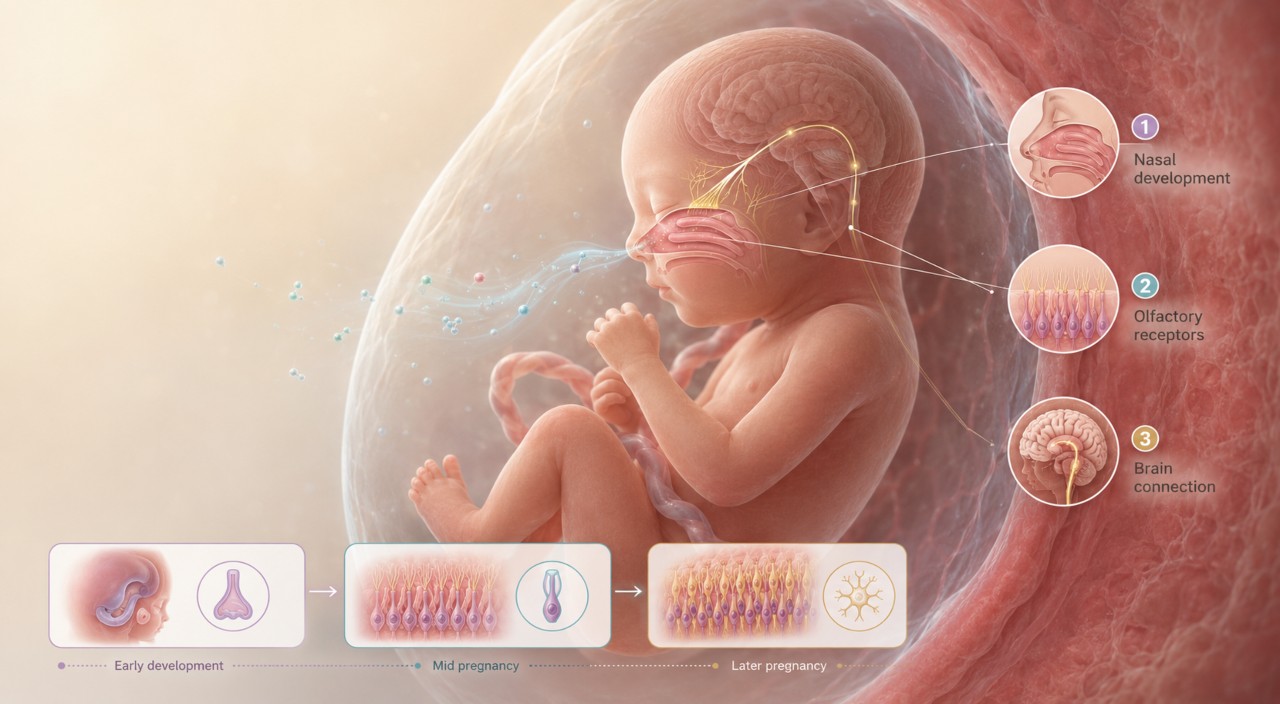

Did you know that a baby’s nose starts forming early in the womb? By just 10 weeks into pregnancy, their smell receptors begin to grow. This early development is key for a baby’s sense of smell, even before they’re born. During pregnancy, they’re exposed to amniotic fluid. This fluid smells like the mother’s milk, helping newborns recognize their mom’s scent right after birth.
Research has shown that newborns have a strong sense of smell. They can tell their mother’s milk from another person’s smell right away. By three months, they can also tell apart familiar scents from new ones. This ability helps them bond and connect with their caregivers. By six months, their sense of smell and taste starts to shape their food likes and dislikes.
The way a baby’s sense of smell develops is truly amazing. It plays a big role in how they bond, feel comforted, and what foods they will like as they grow.
Key Takeaways
- Nasal formations and sense receptors begin developing in the first trimester.
- Newborns can recognize their mother’s scent and differentiate between breast milk sources.
- Newborn olfactory abilities help with early bonding and emotional comfort.
- By three months, babies can distinguish familiar scents from strangers.
- Olfactory and taste preferences start shaping around six months of age.
Introduction to Baby’s Sense of Smell
The development of baby’s sense of smell starts before they are born. From the moment they arrive, babies have a strong sense of smell. This helps them bond with their caregivers and connect to their environment. The sense of smell plays a crucial role in a baby’s development, influencing their taste and food preferences, and fostering emotional connections.
Babies have a sense of smell almost as good as adults when they’re born. This is important for recognizing people, especially their moms. Newborns can quickly learn their mother’s scent, making them feel safe and loved.
In the very first few weeks to three months, babies use their smell to survive. They feel anxious around people with new scents. By six months, their preferences in food flavors start to show. Early scent experiences are key to forming strong bonds through smells.
Did you know familiar scents can bring back memories years later? It shows how infant smell recognition shapes future feelings and thoughts. Parents can help their babies grow by introducing them to different smells. This boosts sensory development and strengthens their emotional connection. “A baby’s sense of smell is not only a vital sense from birth but also a critical element for bonding and emotional development,” explains Dr. Samantha Radford.
When Does a Baby’s Sense of Smell Develop in the Womb?
A baby starts to sense smells early on, shaping their sensory future.
Nasal Formation and Early Development
The journey begins in the first trimester, with rapid development. By 8 weeks, the baby’s nose starts to form, including the nostrils. By week ten, they can detect smells thanks to key receptors.
This formation of nasal parts is crucial fetal development. It lays the sensory foundation for life outside the womb.
Exposure to Amniotic Fluid and Maternal Scents
Smelling the amniotic fluid is key for the unborn baby one’s smell sense development. By 15 weeks, they “taste” flavors in this fluid. This includes their mother’s unique scent.
This exposure to various scents is critical. It helps newborns recognize their mother’s smell, strengthening their bond after birth.
Newborn Olfactory Abilities
Newborn babies are born with amazing smell abilities. These abilities are key for their early bonding and growth. They can recognize their mother’s smell quickly, which helps them feel connected and safe. Even though they can’t see well at first, their sense of smell is sharp.
Recognition of Mother’s Scent
Babies have a great sense of smell right from the start. This lets them know the scent of their own mother early on. It’s vital for forming a close bond between the mom and her baby. Research shows newborns pick their mom’s scent over others, making them feel secure.
Associations with Breast Milk
The link between a mother’s smell and her breast milk is deep. Newborns can tell their own mother’s milk from another’s. They usually prefer their mom’s milk. This preference strengthens the bond and makes babies feel comfortable and familiar.
Breast milk’s scent has a calming effect on babies, helping them emotionally. It’s tied to nourishment and warmth. So, newborns are more likely to eat well and feel safe.
How a Baby’s Sense of Smell Influences Bonding
A newborn’s sense of smell is key in making early emotional ties. These ties come from recognising familiar smells which link them to their caregivers. It’s all part of a complex process that releases oxytocin.
Oxytocin and Emotional Connections
The sense of smell is crucial for forming bonds through scent. When babies smell their mother, it triggers oxytocin release. This makes them feel secure and attached. Such a burst of hormones is vital for a strong bond between mother and infant.
Comfort through Familiar Scents
Newborns naturally prefer their mother’s scent from their time in utero. It’s not just about recognizing their own mothers name, but also finding comfort. These familiar smells soothe babies and help them get used to new environments.
This comfort builds on their experiences with these scents before birth. It ensures babies adjust smoothly from being in the womb to the outside world.
Infant Smell Recognition: How Babies Identify People and Places
Infants have an amazing ability to recognize smells. This helps them bond with their caregivers early on. Their sense of smell is key when their sight is still developing. It helps them know who is who.
Studies show that babies can remember smells from before they were born. This includes their mother’s scent in the amniotic fluid. This ability is crucial for forming a bond with their parents.
Cernoch and Porter (1985) found that infants could recognize maternal axillary odors, a key factor in baby scent bonding.
But it’s not just the baby responds to about recognizing mom. Studies by Porter et al. (1985) show that babies can identify other family members by scent. Parents can also recognize their baby’s unique smell in amniotic fluid. This helps strengthen the bond between child and both parents.
Babies also remember smells of places and things they love. This greatly helps them feel safe and happy. Their familiar smell world helps them bond and understand their social and physical surroundings.
The ability to recognize many different scents is important. It shows how vital our sense of smell is in bonding and development early in life.
Olfactory Development Milestones
It’s key to understand how your baby’s sense of smell develops. It starts with them noticing strong smells more and then learning which scents are familiar or not. By their first birthday, babies will have smells they like and dislike.
1 Month: Sensitivity to Strong Aromas
In the first month, babies show infant scent sensitivity. They react to strong smells. This helps them recognize their mother’s scent, aiding bonding and feeding.
3 Months: Differentiating Known and Unknown Scents
By three months, babies can tell known from unknown scents. This helps them feel safe and bond with their main caregivers. It’s an important step in their olfactory development milestones.
6 Months: Smell and Taste Preferences
At six months, babies develop their taste buds and baby’s smell preferences as they try solid foods. Their sense of smell influences their taste. Genetics also affect how they perceive tastes.
12 Months: Rejecting Unfavorable Scents
As they turn one, babies start to clearly dislike certain smells and tastes. Recognizing bad smells and sour or bitter tastes is a natural development step. Research shows genetics cause these differences, especially in tasting bitterness.
Baby’s Sense of Smell and Feeding
Babies are born with a keen sense of smell. This helps them know their mom’s scent right away. It is important for starting to feed easily.
Impact on Breastfeeding
Breastfeeding and olfactory development go hand in hand. Babies find and recognize their mom’s milk by smell. In 1992, studies by Porter RH and Makin JW showed that babies react to their mom’s scent. This helps them like familiar smells, making breastfeeding easier.
The food a mother eats can change how her milk smells. This was found by Mennella J and Beauchamp GK in 1991. It shows how important smell is for feeding habits.
Introduction to Solids and Smell Preferences
When babies start eating solid foods, smelling helps them pick what they like. By 6 months, they use smell to like or dislike foods. This links to solid foods and baby smell preferences.
In 1988, Hepper PG found that what a mom eats when pregnant affects her baby’s likes later. By 12 months, babies avoid foods that smell bad to them. These early smell experiences are key in choosing what to eat.
Babies like sweet tastes better than sour or bitter ones. This is closely related to their sense of smell. This info helps parents introduce new foods smoothly as babies move from milk to solids.
Maternal Scent Preference and its Role in Comfort
The scent of a mother has a special power. It makes babies feel safe and emotionally well. A study looked into how a mother’s smell affects her baby’s emotions. In it, 62 mothers wore a t-shirt for two nights so their scent could be captured.
Researchers then tested babies between 5 to 10 months old. They used these t-shirts with the mother’s scent. The babies’ brain activity was measured. This was done to see how they react to their mother’s smell under different conditions.
It was clear that babies felt a strong bond when smelling their mother’s arms. This shows both emotional and brain connections.
A mother’s smell is not just about brain links. It baby’s smell preferences also key for soothing. When moms are away, they might leave a piece of their clothing with the baby. This trick helps babies feel close to their mom and secure.
Maternal odor cues also make babies feel secure in new places. These scents help them know who and what is safe. As babies grow, this smell helps them calm themselves and feel emotionally stable. It’s important for their social and brain growth.
Aromatherapy for Babies: What Science Says
Aromatherapy for newborns is getting lots of attention for its benefits. It uses scented essential oils, to help babies feel comfortable and relaxed. Lavender, peppermint, and mandarin are some of the scents used to calm and soothe infants.
Calming Effects of Essential Oils
Research shows how different essential oils can be calming for babies. Sweet almond oil, often used in aromatherapy, has soothing effects, especially when combined with lavender oil. Lavender helps reduce stress and irritation. It makes babies feel more peaceful.
Mandarin has a refreshing effect and helps create a soothing atmosphere. Peppermint is used to ease headaches and nausea. Babies have a strong sense of smell, making aromatherapy especially effective for them.
Safety Guidelines for Using Aromatherapy
Safe aromatherapy use is very important. Parents need to dilute essential oils properly, considering their child’s age and weight. A patch test is recommended to spot any skin reactions in advance. Also, essential oils aren’t regulated by the FDA, so caution is advised.
Think about the environmental impact of using essential oils. Try making homemade items like lavender sock buddies or mandarin dough. Using essential oils for babies should be done carefully, knowing how to keep it safe.
How Pheromones Affect Babies
Pheromones are chemical substances released by humans and animals. They are crucial in how we interact and behave socially. Recent studies show that pheromones impact on infants might be stronger than we thought.
How babies get used to smells affects their bonding with the world around them, especially their parents. Pheromones likely help babies recognize and adapt to their social settings. This is very important in their first days and months.
Research has found that a mom’s pheromones create a feeling of safety and being known. This pheromone-based bonding is key for a baby’s growth in many ways. It impacts their emotional health and how they eat. For animals like mice, knowing their mom’s scent starts off suckling.
The exact effect of pheromones on infants still needs more study. Since it ties closely to scent and child development, more research will likely reveal how these chemical signals affect children’s early experiences and bonds.
Using Familiar Scents to Soothe Your Baby
Using familiar scents is an old trick to calm and comfort babies. It’s known that things like bathing your baby with a scented product can help their motor skills grow. This shows how important it is to soothe your baby with smells, making a cozy place with scent-based calming methods.
Chamomile fragrance draws babies in, much like the smell of breast milk does. This shows babies develop a sense of smell early on. Using items with familiar smells, like clothing or soft toys, can help calm your baby with these scents.
Remembering smells, or olfactory cognition, is crucial for our health. It helps us recognize and recall smells. This is vital for making your baby feel at ease with smells, like those of a parent, which mimic the safety of being held.
- Lavender, chamomile, vanilla, and rose smells are great for helping babies over three months fall asleep. They aid in setting a bedtime routine.
- Chamomile calms and promotes sleep, especially with a warm bath and cuddles.
- Safe fragrances like chamomile are preferred for baby bath and skincare items, to avoid harmful effects.
Studies highlight how a mother’s scent brings comfort. In research with 62 mothers, the connection in brain activity between mothers and babies was stronger when they were face-to-face instead of not looking at each other. Even with a stranger, the baby’s brain activity was similar to that with the mother if there was a T-shirt with the mother’s scent.
This brain connection brings comfort, especially in new situations like daycare or family visits. So, soothing your baby with familiar scents doesn’t just help emotionally but also strengthens brain connections. This builds a sense of safety and happiness in your baby.
Encouraging Healthy Olfactory Development
Helping your baby develop a strong sense of smell is key for their sensory growth. By introducing them to various scents, you help them understand their world better. This helps them react to their surroundings in meaningful ways.
Exposure to a Variety of Odors
Exposing babies to many scents is beneficial. It’s important for their sense of smell to grow. Studies show that sensory experiences start early, even before birth, with the olfactory bulb forming in the womb.
Offering different smells, both natural and man-made, aids in this growth. Babies like sweet smells like vanilla and quickly enjoy new ones, especially when breastfeeding.
Creating a Scent-Friendly Environment
Creating a safe space with pleasant smells is important. Using non-toxic scents helps babies recognize and feel comforted by familiar smells. This can make them feel safer and more at ease.
Infants react to smells with facial and body movements. They prefer smells they know, even just after two days. Adding a variety of safe scents at home supports their sensory progress. It also makes your home more comforting.
In conclusion, exposing babies to different smells and ensuring a scent-friendly environment helps their sense of smell. This is key for their overall sensory and emotional well-being.
Conclusion
Understanding the stages of how babies smell things offers deep insight. It shows how they connect with their surroundings. From the time they grow in the womb, babies start to recognize their mother’s scent. This tells us just how important smells are to them.
By 29 weeks in the womb, babies have a working sense of smell. When they are born, this sense is even more developed than their sight. This fact shows how crucial their sense of smell is from an early age.
Helping babies develop their sense of smell is vital. It helps build a strong bond and supports their healthy growth. Mothers can even recognize their baby’s scent right after birth. This highlights how important smell is for connecting with each other.
Babies begin to tell different smells apart soon after they’re born. Their early ability to distinguish scents shows how quickly their smell develops. Introducing them to various scents can help improve this important sense.
The role of a baby’s sense of smell goes beyond just forming bonds. It also affects how they eat and get to know their mother’s presence. By understanding and supporting their sensory journey, we help them grow healthily. Research shows babies start learning different smells even before birth. Encouraging this learning is key to their emotional and overall well-being.
FAQ
When does a baby start developing their sense of smell?
A baby begins to develop their sense of smell normal hearing very early on, in the womb. By the tenth week, they have the receptors they need to detect smells.
How does a baby recognize their mother through smell?
Newborns can spot their mother just by her natural scent. This special ability helps them bond and feel comforted, recognizing her unique smell from others.
What is the role of smell in breastfeeding?
The smell of the mom’s breast milk, first met in the womb, draws newborns to it. This connection aids in the success of breastfeeding.
How do familiar scents comfort a baby?
Well-known scents, like that of a mom, make babies feel secure and connected. This kind of scent bonding helps them feel comfortable in new surroundings.
Are there specific olfactory development milestones for infants?
Yes. At one month, babies react to strong smells. By three months, they tell apart familiar and new scents.
At six months, they start having favorite smells. By one year and a few drops in, they begin avoiding scents they don’t like.
Can aromatherapy be used for babies?
Aromatherapy, using mild essential oils like lavender, can be soothing for babies. But, it’s important to use it safely to avoid harming the baby’s sensitive skin or health.
How do pheromones affect babies?
Pheromones could help babies bond socially with their parents. These chemicals assist in recognizing and getting used to their family, though research is ongoing.
How can I encourage healthy olfactory development in my baby?
Expose your baby to various safe smells to boost their smell development. A world rich in different odors supports their sensory growth, making learning about smells fun.
References
- How and when your baby’s sense of smell develops – https://www.babycenter.com/baby/baby-development/baby-sensory-development-smell_10401106
- When Babies Begin to Smell – https://www.whattoexpect.com/pregnancy/fetal-development/fetal-smell/
- Stimulating your baby’s senses series: Smell – https://www.bounty.com/baby-0-to-12-months/development/baby-senses-smell
- Exploring Newborn Senses – https://www.chapeds.com/blog/1172900-exploring-newborn-senses/
- Newborn Senses – https://www.stanfordchildrens.org/en/topic/default?id=newborn-senses-90-P02631
- Newborn-Senses – https://www.chop.edu/pages/newborn-senses
- What Your Developing Baby Actually Sees, Hears, and Feels During Pregnancy – https://www.parents.com/pregnancy/stages/fetal-development/babys-alertness-in-the-womb/
- The newborn senses: What can babies feel, see, hear, smell, and taste? – https://parentingscience.com/newborn-senses/
- The Newborn Senses: Taste & Smell – Lozier Institute – https://lozierinstitute.org/dive-deeper/the-newborn-senses-taste-smell/
- Olfaction scaffolds the developing human from neonate to adolescent and beyond – https://www.ncbi.nlm.nih.gov/pmc/articles/PMC7209940/
- Babies Smell Wonderful to Their Parents, Teenagers Do Not: an Exploratory Questionnaire Study on Children’s Age and Personal Odor Ratings in a Polish Sample – https://www.ncbi.nlm.nih.gov/pmc/articles/PMC5574933/
- Developmental milestones: smell – https://www.babycentre.co.uk/a25013415/developmental-milestones-smell
- Chemical communication and mother-infant recognition – https://www.ncbi.nlm.nih.gov/pmc/articles/PMC2717541/
- The gustatory and olfactory systems during infancy: Implications for development of feeding behaviors in the high risk neonate – https://www.ncbi.nlm.nih.gov/pmc/articles/PMC3223371/
- Baby Senses Development – Activities to Try | Pathways.org – https://pathways.org/olfactory-gustatory-senses-activities/
- Your Baby’s Sense of Smell – BabySparks – https://babysparks.com/2019/02/22/your-babys-sense-of-smell/
- Clinical Usefulness of Maternal Odor in Newborns: Soothing and Feeding Preparatory Responses – https://www.ncbi.nlm.nih.gov/pmc/articles/PMC2046216/
- Smelling Moms’ Scent May Help Infants Bond With Strangers – https://www.smithsonianmag.com/science-nature/smelling-moms-scent-may-help-infants-bond-with-strangers-180979200/
- How aromatherapy can help kids breathe in some mental goodness – https://www.nationalgeographic.com/premium/article/help-kids-breathe-in-some-mental-goodness-with-aromatherapy
- Activation of Olfactory Cortex in Newborn Infants After Odor Stimulation: A Functional Near-Infrared Spectroscopy Study – Pediatric Research – https://www.nature.com/articles/pr2000148
- How scent, emotion, and memory are intertwined — and exploited – https://news.harvard.edu/gazette/story/2020/02/how-scent-emotion-and-memory-are-intertwined-and-exploited/
- Pheromones for Newborns – Neurobiology of Chemical Communication – https://www.ncbi.nlm.nih.gov/books/NBK200997/
- Baby’s Superpowered Scent Can Manipulate Parents’ Moods, Researchers Find – https://www.voanews.com/a/baby-s–superpowered-scent-can-manipulate-parents-moods/6320932.html
- Babies learn the smell of mum – https://www.sanger.ac.uk/news_item/2012-10-04-babies-learn-the-smell-of-mum/
- Why Fragrance in Baby Products is a Good Thing – https://www.cetaphil.co.nz/skincare-tips/fragrance-in-baby-products.html
- T-Shirt Study Shows Importance of Mom’s Smell to Bond With Baby – https://www.healthday.com/health-news/women-health/12-13-t-shirt-study-shows-importance-of-mom-s-smell-to-baby-s-bond-2655927897.html
- Promote the Awakening and Development of the Child by Smell | 5senses4kids – https://5senses4kids.org/en/olfaction-the-sense-of-smell/
- PowerPoint Presentation – https://www.azdhs.gov/documents/prevention/nutrition-physical-activity/breastfeeding/educational-opportunities/sensory-experience-of-the-newborn.pdf
- Sampling, identification and sensory evaluation of odors of a newborn baby’s head and amniotic fluid – Scientific Reports – https://www.nature.com/articles/s41598-019-49137-6
- Early Interplay of Smell and Sight in Human Development: Insights for Early Intervention With High-Risk Infants – Current Developmental Disorders Reports – https://link.springer.com/article/10.1007/s40474-023-00285-5